
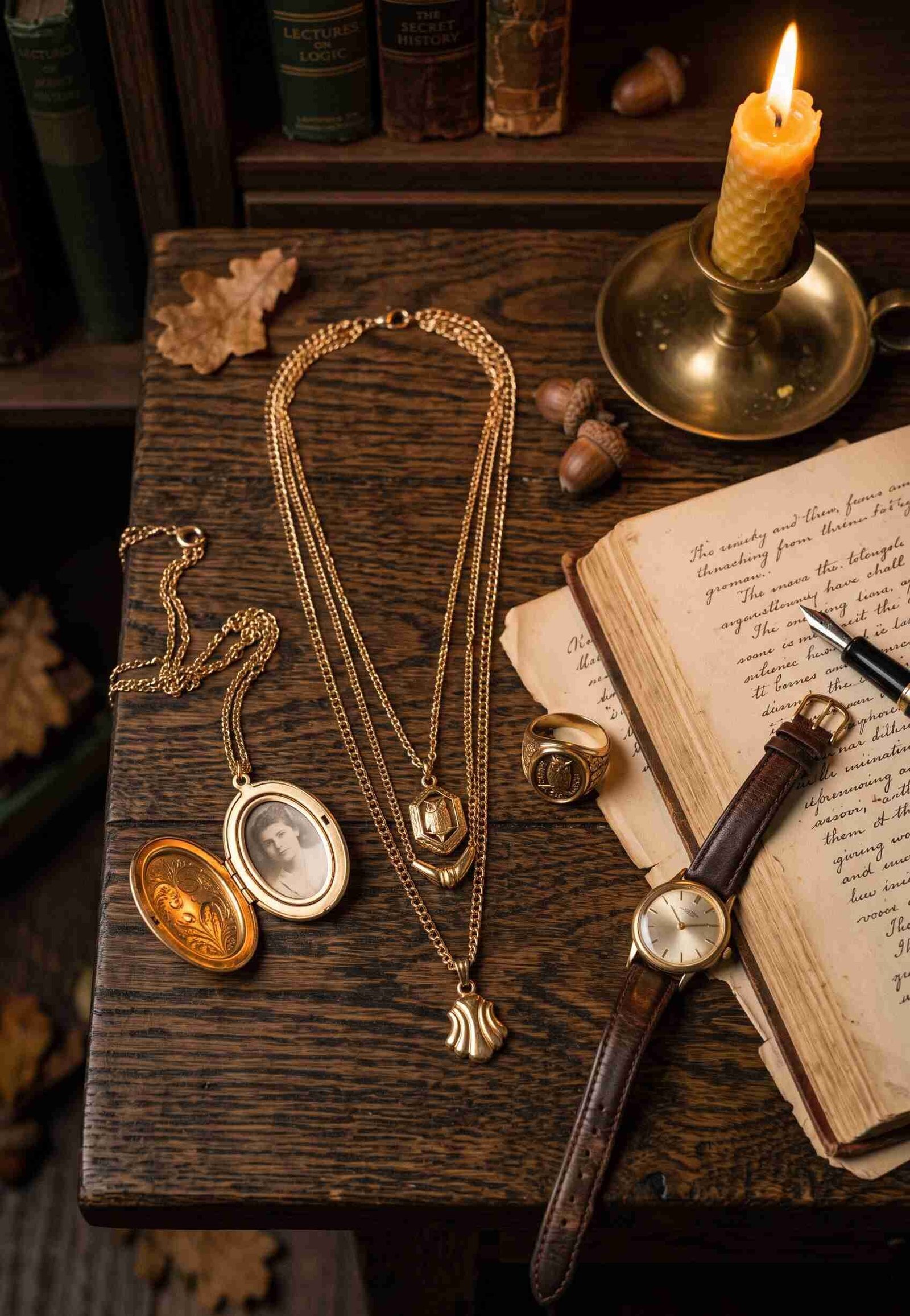
Dark academia jewelry is vintage-inspired jewelry in warm, aged metals — an engraved locket, a signet ring, a thin layered chain, or a dark-stone ring in garnet or onyx.
Wear it sparingly, so each piece looks inherited or found, not bought as a matching set. Start with one meaningful piece, keep the finish matte or lightly tarnished, and let everything else stay quiet.
That restraint is the point. This guide breaks the look down piece by piece — metals, stones, how each item is worn, and how to combine them without costume.
Start With the Metal, Not the Trend
Colour temperature matters more than price. Yellow gold, antique brass, and bronze sit comfortably beside tweed, wool, oxblood leather, deep green, navy, and cream.
Bright chrome and mirror-polished silver pull the other way. They reflect too much light, look newly manufactured, and clash with muted fabrics.
Silver is not banned completely. Oxidised silver, with darkness settled into the engraving, can work well on signet rings and chains worn under a collar.
Why a Little Patina Helps
Patina is not damage. On brass, bronze, and copper alloys, air, moisture, and skin oils slowly form surface oxides that deepen colour and soften shine.
Over long exposure that process can produce verdigris, the green tone of very old copper-based metal. On jewelry you want only the early stage — a warm dulling, not green crust.
Gold behaves differently. Solid gold does not tarnish the same way, but it picks up film from lotions and soap.
Gold vermeil — a thick layer of gold over sterling silver — needs gentler handling. Friction and harsh polishing can wear its surface away.
The Neck: Lockets, Chains, and Pendants With a Past
The neck is where most people should start. A single pendant on a fine chain changes a plain knit, white shirt, or slip dress more than any other item.
The Locket Is the Signature Piece
Lockets have carried something hidden for centuries. Early 16th-century examples held perfume-soaked cloth or charms, and Queen Elizabeth I popularised the locket ring in the 1570s.
By the Victorian period they held miniature portraits, then photographs, and often a lock of hair.
The V&A Museum holds a 19th-century gold locket made to commemorate a death in 1871, with a photograph on one side and hair on the other.
The museum notes lockets were particularly fashionable keepsakes from about 1860 to 1880. That history is why they still anchor this aesthetic so well.
Choose oval over novelty shapes. An engraved floral, starburst, or plain brushed front in antique gold or brass looks right; a glossy crystal-covered heart does not.
Wear it at princess length, roughly 45 to 50 centimetres, just below the collarbone. That places it over a jumper or in the open V of a blouse.
Cameos, Coins, and Small Symbolic Pendants
If a locket feels too romantic, try a cameo profile, an old-coin pendant, a wax-seal charm, or a tiny key or book motif.
Keep pendants small — thumbnail to postage-stamp size. Seals imply letters, keys imply locked libraries, and cameos echo classical art.
The Plain Chain, Worn Deliberately
A fine curb, figaro, or rope chain needs no pendant. Worn alone over a black roll-neck, or glinting at a shirt collar, it is the most understated option for everyone.
Keep it thin. One delicate chain reads as intentional; one thick chain becomes the entire outfit.
The Hands: Signets, Dark Stones, and Quiet Stacks

Hands are constantly in view — holding a book, a cup, a pen. One good ring often does more than a necklace hidden under layers.
The Signet Ring and What It Used to Do
The signet was a tool before decoration. From ancient Egyptian scarab rings to medieval seals, an engraved crest or initial was pressed into wax to authenticate letters.
Only the owner held that exact seal, so signets signalled identity and authority. Families passed them down as heirlooms.
You do not need a family crest today. A plain oval face, your initial, a classical head, a bee, or a botanical engraving gives the same weight honestly.
Traditionally worn on the little finger, it also sits well on the ring finger. Let it be the widest ring you wear.
Dark Stones That Belong Here
Garnet is the classic stone ring choice. Victorians associated its deep red with loyalty and fidelity, and garnet use in jewelry dates back to ancient Egypt.
Black onyx is the other anchor. Its polished black surface made it a favourite for Victorian mourning jewelry.
After Prince Albert died in 1861, Queen Victoria’s long mourning shaped fashion for decades. Dark stones, black enamel, and jet became everyday mourning wear.
Jet — lightweight fossilised wood famously worked in Whitby, Yorkshire — filled that role at lower cost. Modern black glass can echo its look affordably.
Amber, smoky quartz, bloodstone, carnelian, and deep amethyst also fit. Victorians linked amethyst to grief and spirituality, so it appeared beside onyx and garnet.
Skip neon stones and huge clear crystals. The palette should suit a wooden library: wine red, ink black, honey, smoke, and dull gold.
Stacking Rings Without the Clutter
Stack thin bands on one or two fingers and leave the rest bare. Mix one wider signet or stone ring with two slim plain bands for contrast.
Odd groupings settle better visually — three rings on a hand usually look more resolved than two or four competing evenly.
If every finger is covered, nothing stands out. An empty finger is part of the design.
Ears and Lapels: Details People Notice Up Close
Earrings stay close to the face here. Small pearl drops, tiny gold hoops, garnet or onyx studs, and short antique-style drops are the range.
Pearls carry history in this context. Victorians used pearls to represent tears in mourning jewelry, giving a simple stud quiet sentimental weight.
Choose baroque or slightly irregular pearls over perfectly matched plastic-white spheres. A warmer, creamier tone flatters the metals and avoids a bridal look.
Chandelier earrings and oversized hoops belong elsewhere. This style keeps the silhouette tidy and bookish.
Brooches and Cameo Pins
A brooch at a blazer lapel, cardigan button line, or scarf knot adds an off-centre focal point necklaces cannot. Cameo, enamel, and mourning-style brooches have 19th-century roots.
During strict Victorian mourning, the priciest black pieces were onyx or enamelled gold. Jet, bog oak, and glass served a far larger market — material can flex, silhouette should not.
One brooch is enough. Pin it where fabric is firm, and check it sits level rather than dragging the lapel down.
The Wrist: A Watch Counts as Jewelry Here
A slim analogue watch on a worn brown or black leather strap is often the only wrist piece you need. A small round face and simple markers keep it in period.
Oversized sports cases, mirror-polished link bracelets, and smartwatches pull toward technology. Leather instead matches belts, satchels, and book covers.
If you add a bracelet, keep it fine and on one wrist: a single chain, a thin bangle, or a dark onyx or wood bead strand.
Cufflinks follow the signet rule. Simple brass, bronze, enamel, or dark-stone designs for formal shirts — no novelty shapes or logos.
Putting Pieces Together: Three Combinations That Work

Layering fails when pieces share the same length, thickness, and shine. It works when each layer has a different job and a clear gap.
Use staggered lengths as a map: a close layer at 35–40 cm, a mid layer at 45–50 cm, and a longer layer at 55–65 cm.
Limit yourself to two or three necklaces. Vary thickness too — a fine chain beside a slightly heavier one reads as depth; three identical chains read as repetition.
For a Day of Lectures, Libraries, or Work
Start with the locket at mid length. Add a signet or one thin ring stack, plus small studs if you like, and stop.
This pairs most naturally with the layered shirts, knits, and blazers in our guide to how to dress like dark academia from head to toe.
For a Softer, More Romantic Version
Layer the locket over a shorter fine chain. Swap the signet for a garnet ring, and choose pearl drops instead of studs.
The stones and pearls soften the look without adding brightness or extra pieces.
For Evening or a Formal Blazer
Keep the neck to one pendant. Move interest to the lapel with a cameo brooch, and let the watch and cufflinks finish the wrists.
Formal versions use fewer pieces, placed more precisely. Pick one focal zone — neck, hands, or lapel — and let the others support it.
Buying Secondhand and Caring for Old Finishes
Secondhand is genuinely better than new here. Thrift shops, estate sales, and antique markets already stock the lockets, signets, and cameos this style copies.
Search by object, not aesthetic name. Filter for “locket,” “signet,” “cameo,” “garnet ring,” and “gold vermeil” — the aesthetic label often adds a markup.
Check working parts first. Open the locket, test rings for thin or cracked shanks, feel stone settings for loose claws, and confirm brooch pins work.
Ask what the metal actually is. Solid gold, vermeil, gold-filled, plated, and gold-tone brass look alike in photos but wear very differently.
Store pieces dry and separate so chains do not abrade pendants. Put jewelry on last, after perfume and hairspray, especially with pearls and plating.
Clean gently with warm water, mild soap, and a soft cloth. Never soak pearls, avoid abrasive dips on vermeil, and do not polish bronze back to a shine.
One solid locket or signet worn weekly beats five flimsy pieces bought in one order. For layering it over coats and scarves, see our dark academia winter outfits guide for how jewelry sits with high collars.
Mistakes That Break the Illusion
Buying a full matching set. Coordinated sets in identical motifs look manufactured for one season. This style should look gathered over time, piece by unrelated piece.
Polishing everything to a mirror shine. Over-cleaning removes the age the aesthetic depends on — and on plated or vermeil pieces, it can remove the gold layer itself.
Mixing metals by accident. A brass locket, cool silver ring, and rose-gold watch rarely look intentional together. Master one warm metal family first.
Going too big, too often. A large pendant, large earrings, and a large ring together overwhelm the clothing. Let one bigger piece be the exception.
Using symbols from the wrong aesthetic. Skulls and heavy occult graphics tip an outfit into fancy dress. Classical, botanical, and literary motifs are the safer vocabulary.
Ignoring neckline and collar. A pendant hidden under a high collar or tangled in a scarf does no work. Match chain length to the garment first.
Frequently Asked Questions
Can I wear silver if everything else is gold-toned?
Yes, if it is antiqued or oxidised and repeated at least twice, such as a ring and a chain. One bright silver piece among warm metals usually looks accidental.
Is a locket too feminine for a men’s outfit?
No. Lockets and locket rings were historically worn by men and women. Choose a plainer, heavier oval on a longer chain and wear it under an open collar.
How do I tell if a thrifted ring is worth buying?
Check the band is round and not thinned at the back, stones sit tight with no rattle, and engraving looks worn, not blurred by thick plating.
A solid plain signet in the wrong size is often worth resizing. A cracked stone setting usually is not.
Do I need real gemstones for garnet or onyx pieces?
Not for the look. Both stones are relatively accessible naturally, so genuine secondhand pieces are often affordable, but well-cut glass in the same deep colours works visually.
Spend first on metal and setting. Those decide how long the piece actually lasts.
How many pieces should I wear at once?
Three to five items total works for most outfits: a locket, a signet, studs, and a watch, for example. If removing one piece makes it calmer, that piece was one too many.
A Small Collection, Chosen Slowly
Begin with the piece you will touch most: a ring you turn while reading, a locket you open, a watch you check instead of a phone.
Add the next piece only when an outfit keeps feeling unfinished in the same place. Necklace first for most people, then ears or lapel, then a second ring.
Chosen that way, a handful of warm-metal, dark-stone pieces covers almost every version of the aesthetic — and each one looks like it was already yours.