

A dark academia room works when you build it in layers: deep, muted colour first, warm low light second, real books and worn wood third. You do not need to repaint everything or buy antique furniture to get there.
Start with what you already own, change the light, and put books where you can see them. In a rented bedroom or small dorm, those moves alone shift the mood in one afternoon.
This guide is a blueprint, not a shopping list. Work through it element by element — walls, light, library, desk, bed, art, and objects — and stop when the room feels right.
Why This Look Feels Different From a Normal Bedroom
Dark academia began online in the mid-2010s on Tumblr, then spread widely during the pandemic. It romanticises old universities, classical literature, and long evenings spent reading.
According to the overview of dark academia, its imagery centres on Collegiate Gothic architecture, candlelight, dark wooden furniture, and dense, book-filled rooms linked to Oxford and Cambridge.
That origin matters for decor. You are recreating a small personal library where someone actually studies and writes — not copying a themed hotel room.
So test every choice simply: would this belong in a scholar’s room? If it helps you read, write, or linger, it fits. If it only fills a shelf for a photo, it does not.
The Blueprint at a Glance
Think of the room in five zones, even if they overlap: sleep, study, library, light, and display. A bedside book stack can be library and display at once.
Balance matters more than size. No zone should shout louder than the others, and none should be left bare while another is crowded.
The Materials That Carry the Style
Dark wood, leather, velvet, wool, brass, and aged paper do most of the work. They look warm under low light and improve with wear.
Glossy plastic and chrome pull the other way. Keep them hidden in drawers or closed boxes where you can.
Remember one rule if nothing else: matte over shiny, natural over synthetic, worn over pristine.
Layer One: Colour and Walls — The Weather of the Room
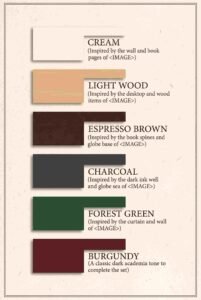
The classic palette is narrow for a reason. Espresso brown, forest green, burgundy, charcoal, and warm cream create depth without fighting each other.
Brass and antique gold are the small bright notes — a lamp base, a frame edge, a bookend. Treat them like punctuation, never the whole sentence.
For a warmer room, lean on brown, burgundy, and olive. For a cooler, formal room, lean on charcoal, navy, and deep green.
If You Can Paint — and If You Cannot
If painting is allowed, one wall is enough. Deep green or espresso behind the bed or desk changes the room more than four pale walls.
If you rent, leave walls alone. Carry colour through curtains, bedding, a rug, and book spines instead — the effect is surprisingly close.
Avoid painting everything black. This style is brown and green at heart, and black walls flatten books and wood into one dull mass.
Layer Two: Light — The Fastest Transformation
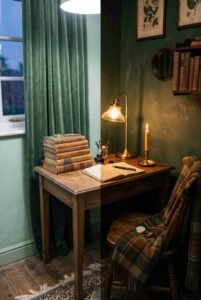
Turn off the ceiling light and judge the room honestly. Most bedrooms feel harsh because one cool overhead bulb floods everything evenly.
Replace it with two or three small pools of light: a desk lamp, a bedside lamp, and perhaps a floor lamp in a corner.
Choose bulbs around 2700K. Lighting guides describe that level as soft, golden, and candle-like — ideal for evening reading, while 5000K and above feels clinical.
Candles, Real and Otherwise
Candlelight is part of the aesthetic’s DNA. A cluster of pillar candles on a tray gives flicker that no bulb quite matches.
Where flames are banned, flameless candles work well. Hide them in amber glass or brass holders so the source looks aged, not plastic.
Let shadows exist after dark. A room with no corners has no mood, however good the furniture is.
Layer Three: The Library — Books as Architecture
Books are not an accessory here. They are building material, and a room without visible books will never quite convince.
A tall full bookcase is ideal, but not essential. Stacks on a nightstand, a leaning row on a sill, and an open book on the desk all count.
Mix upright rows with horizontal stacks. Perfectly uniform shelves look like a shop display, not a lived-in study.
Building a Collection Cheaply
Library sales and charity shops sell hardcovers very cheaply, sometimes by weight. Cloth bindings in green, brown, and burgundy are decor gold.
Buy books you might actually read. A shelf you dip into feels more honest than props you never open.
For a starting shelf, our guide to essential dark academia books worth reading and displaying pairs loved titles with editions that look beautiful displayed.
Styling the Shelves
Leave breathing room. Bring some books forward, push others back, and lay one stack sideways with a small object on top.
Use brass, stone, or dark wood bookends for leaning rows. Hide chargers and cables in closed boxes below the shelves.
Layer Four: The Desk — A Place That Invites Writing

The desk is the emotional centre of the room. Even a small thrifted oak table in a corner signals work done slowly and well.
Dark-stained wood is forgiving. Mismatched secondhand pieces look unified once they share a similar tone, and scratches help rather than hurt.
Keep the surface mostly clear: a lamp, a journal, a pen pot, and one stack of current reading is plenty.
Details That Change How Sitting Down Feels
A fountain pen, brass paperweight, or ink bottle adds ritual to ordinary homework or journaling for very little money.
Add comfort for long sessions — a leather cushion or a wool throw over the chair back softens hard wood.
Face the desk toward a calm wall with a print or map if the room is busy. It gives the study zone a clear boundary.
Layer Five: The Bed and Textiles — Warmth You Can Feel
Bedding should be plain, layered, and tactile. Warm cream sheets as a base, then a darker cover in green, brown, or burgundy on top.
Add texture in thin layers, not bulk. A wool throw at the foot of the bed and one or two velvet or tweed cushions read richer than novelty pillows.
A faded Persian-style rug, even a small secondhand one, anchors everything. Its worn pattern ties wood, books, and bedding together.
Curtains and Daytime Light
Heavy curtains in deep green or burgundy soften daylight and give that enclosed, panelled study feeling. Muted linen works if velvet feels too heavy.
If you need privacy sheers, layer them behind a darker outer curtain. Sheers alone will fight the palette all day.
Layer Six: Walls — Prints, Maps, and Quiet Art
Bare walls make a room feel temporary. A small gallery of framed prints gives it memory, as if ideas accumulated over years.
Botanical illustrations, old maps, anatomical drawings, and classical portraits suit the mood. Public-domain museum images can be printed cheaply at home.
Use thin black, dark wood, or aged gold frames. Thrifted frames in mixed sizes look more collected than a matching set.
Hanging Without Damaging a Rental
Use picture strips, or lean larger frames on a shelf or desk against the wall. The informal lean suits this style well.
Hang art at seated eye level, not standing. You will see it from a chair or bed far more often.
Resist covering every wall. One strong cluster plus one larger piece, like a map, beats thin art scattered everywhere.
Layer Seven: Objects With a Past — One Story Is Enough

Every memorable room here has one curiosity: a globe, typewriter, chess set, hourglass, or brass telescope.
Choose one hero piece and give it space. Five curiosities on one shelf look like a gift shop; one looks like a life.
Buy secondhand where you can. Patina and a small flaw make an object believable, and thrift shops are full of brass, wood, and glass.
Plants and Natural Touches
A little green life stops the room feeling like a museum. Try a trailing pothos on a shelf or a fern in a terracotta pot.
Dried flowers or eucalyptus in a dark glass bottle also work, with no watering routine. Keep it restrained — this is a library, not a jungle.
Putting the Blueprint Together on a Budget
This style is kind to small budgets because age is the point. Spend in the order that changes the room most for the least money.
First, warm bulbs and one secondhand lamp. Second, books. Third, one textile layer like a wool throw.
Only then buy a hero object or framed prints. By then you will know what the room actually lacks.
Three Levels, Same Result
Almost nothing: rearrange books visibly, borrow a lamp, print public-domain art, and fold your darkest blanket over the bed.
Small spend: a thrifted lamp, charity-shop throw and cushions, framed prints, and flameless candles. Most bedrooms turn the corner here.
One investment: a solid secondhand wooden desk or bookcase, stained dark if needed. One substantial piece anchors cheaper finds for years.
The same palette runs through clothing. If you like the full mood, see how to dress like dark academia for the matching wardrobe colours and fabrics.
Common Mistakes That Quietly Ruin the Effect
Making everything black. Black walls, bedding, and furniture merge into a flat box. Brown, green, and burgundy give darkness with depth.
Leaving the overhead light on. One cool ceiling bulb undoes everything else. Use it to clean or dress, then switch back to lamps to live in the room.
Buying a matching themed set. Rooms collected slowly convince; rooms bought in one afternoon do not. Mix shops, periods, and sources.
Decorating only for one camera angle. Spread light and colour evenly, so the room feels calm from the bed, not just from the door.
Forgetting to live in it. An open book and a half-written page are the final layer. A room nobody reads in always looks like a set.
Frequently Asked Questions
Can I create this look in a very small room or dorm?
Yes — small rooms often suit it best because the mood relies on enclosure. Go vertical with shelves and stacked books, and keep the palette tight so it feels cosy, not cluttered.
What if my furniture is modern and light-coloured?
Keep it and dress around it. A dark throw over a light chair, plus books and a brass lamp on a pale desk, shifts the whole piece without replacing it.
Do I need to paint my walls dark?
No. Many convincing rooms keep cream walls and carry darkness through textiles, wood, books, and art. One dark wall is a shortcut, never a requirement.
How do I stop the room feeling gloomy in winter?
Add light sources, not brighter light. An extra low lamp, a candle cluster, and warm cream textiles lift the mood while keeping the glow golden.
Is dark academia just for students?
Not at all. The study references are a visual language, not an age limit. Anyone who reads or works at home can use this blueprint for a quieter, more focused room.
A Room You Build Slowly, and Keep
Do not try to finish this room in a weekend. Add the light, live with it, add the books, and let each piece earn its place.
That slow growth is why the style lasts. A room built around books you love and objects with stories will not date in a season.
Start tonight: ceiling light off, lamp on, book open. If that corner feels right, the rest will follow.