
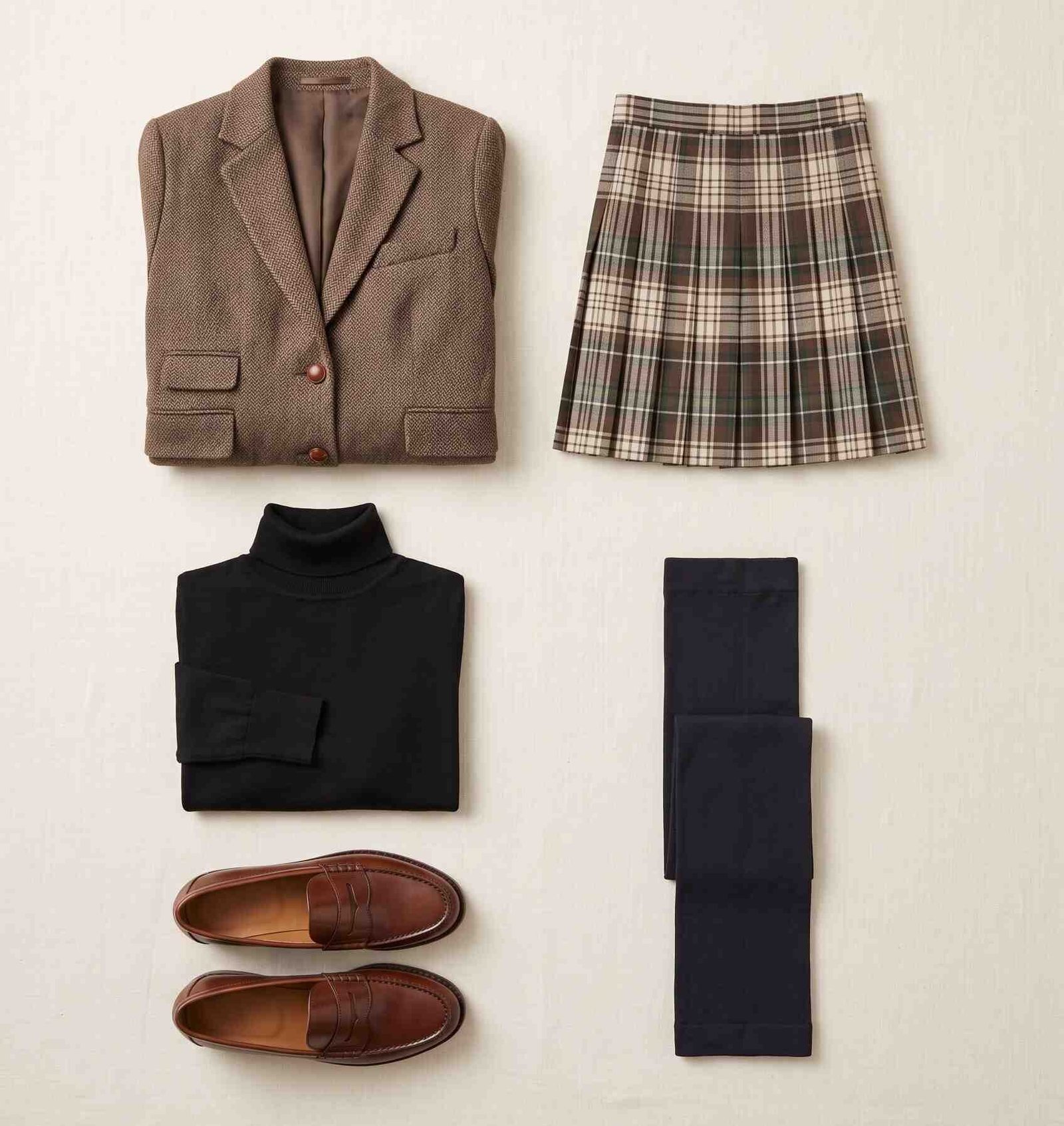
The most wearable dark academia outfit ideas for women start with a small system, not a costume: a fitted turtleneck or collared shirt, a pleated skirt or tailored trousers, a structured blazer or long coat, tights, and flat leather shoes, all in espresso, charcoal, forest green, burgundy, and cream. Build those pieces once, then recombine them by season and occasion.
This guide shows how the system works: palette rules, the core pieces worth owning, a repeatable layering formula, and combinations for class, work, weekends, and evenings.
What Makes an Outfit Read as Dark Academia, Not Just Dark
Colour alone is not enough. An all-black outfit with no texture usually reads minimalist or goth, because dark academia depends on texture, tailoring, and visible layers working together.
The fashion draws on 1930s and 1940s dress from Oxbridge, Ivy League, and prep schools, according to the overview of dark academia. Cardigans, blazers, dress shirts, plaid skirts, and Oxford shoes appear again and again for that reason.
The wider culture started on Tumblr in 2015 and spread widely during the pandemic. Its literary anchors include Donna Tartt’s The Secret History, Oscar Wilde, and the Romantic poets, which explains the bookish, slightly melancholic mood.
For women, the translation is practical. Keep silhouettes tailored at the waist, hems at the knee or midi length, and fabrics matte and textured rather than shiny or floaty.
Start With Colour and Fabric, Not With Individual Outfits
Most failed attempts start in the wrong place. Someone buys a dramatic skirt, then discovers it matches nothing they own and feels too theatrical to wear twice.
Work in the opposite order. Lock the palette first, choose fabrics that create depth inside that palette, and only then buy pieces.
The palette that does the heavy lifting
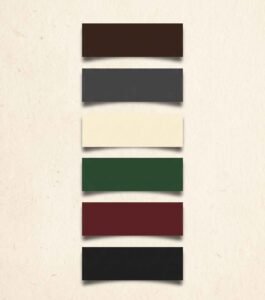
Build around four base colours: espresso brown, charcoal, black, and antique cream. These four combine with each other in almost any order without clashing.
Add two or three accents for variety: forest green, burgundy or oxblood, navy, and a muted mustard. Use accents one at a time, in a skirt, a knit, or a scarf, never all at once.
Avoid bright white, neon, and pastel candy tones. They break the aged-paper quality of the palette, which should feel like old book pages, brass, and dark wood.
Fabrics that create the texture
Texture is what stops a dark outfit looking flat. Tweed, wool, corduroy, velvet, and leather each catch light differently, so a tonal outfit still has depth.
Classic patterns belong here too. Plaid, houndstooth, herringbone, and argyle signal school and university dress without needing logos, slogans, or graphics.
Use one patterned piece per outfit. If the skirt is plaid, keep the top and blazer solid; if the blazer is tweed, let the skirt or trousers stay plain.
For warmer months, swap the fabric, not the idea. Linen, cotton poplin, and lightweight wool blends keep the same colours and shapes while breathing properly.
The Core Wardrobe: Twelve Pieces That Mix Freely
You do not need a full new wardrobe. Twelve well-chosen pieces, all inside the palette, produce weeks of combinations because every top works with every bottom.
Think in four groups: bases you wear against the skin, bottoms that set the silhouette, layers that add structure, and shoes that finish the line.
Bases: turtlenecks, shirts, and fine knits
Own a fitted turtleneck in black and another in cream. It is the hardest-working base in this style, sitting cleanly under blazers, pinafores, vests, and coats.
Add a cotton Oxford or poplin shirt in cream or soft white. The collar showing above a sweater or vest is one of the clearest academic signals you can wear.
A fine-knit crew or V-neck in burgundy or forest green completes the group. Fine knits layer without bulk, which matters when you add two more pieces on top.
Bottoms: pleats, plaid, and tailored trousers
A pleated skirt in plaid wool or a wool blend is the signature bottom. Knee length suits daytime best; midi length feels more grown-up and works better for work.
High-waisted, wide-leg or tapered trousers in charcoal, brown, or corduroy give you the non-skirt option. Worn at the natural waist, they lengthen the leg and tuck neatly.
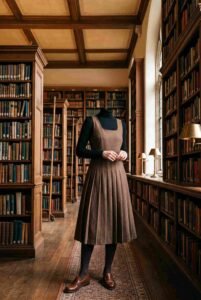
If you prefer dresses, choose a pinafore or a belted midi dress in a solid dark tone. One dress replaces a top and bottom on rushed mornings.
Layers: the pieces that add the scholarship
A structured blazer in brown or charcoal tweed is the fastest route into the aesthetic. Fitted at the waist, it turns a plain shirt and skirt into something deliberate.
Add a sweater vest or a long cardigan for the middle layer. Vests work over shirts in autumn; long cardigans soften trousers and suit long library or study sessions.
Finally, a long wool coat or trench for outdoors. Camel, charcoal, and black are the safest colours, and a belted shape keeps the silhouette tidy rather than swamped.
Shoes and legwear: the finishing line
Oxfords, loafers, and Mary Janes in brown or black leather are the standard shoes. They are flat, polished, and quiet, which is exactly what the rest of the outfit needs.
Ankle boots or knee boots take over in winter and rain. Keep heels low and shapes simple, so the boot supports the outfit instead of competing with it.
Opaque tights in black or dark brown are not an afterthought. They connect skirt to shoe, add warmth, and keep a shorter hem feeling intentional in cold weather.
The Layering Formula Behind Almost Every Good Look
Once the core pieces exist, getting dressed becomes a formula. Start thin and close to the body, then add one layer of warmth, then one layer of structure.
Let each layer show at the edges. A collar above a knit, cuffs past a blazer sleeve, and a turtleneck neckline under a pinafore are the details people actually notice.
Balance one structured piece against one softer piece. A sharp blazer relaxes over a fine knit; a slouchy cardigan needs a crisp shirt and tailored trousers beneath it.
New to the wider wardrobe logic behind this? The beginner guide to how to dress like dark academia from scratch walks through the staples before you start combining them.
Outfit Formulas by Occasion
For class, lectures, and the library
Wear a cream turtleneck under a herringbone or tweed blazer, with a pleated wool skirt, opaque tights, and loafers. Add a leather satchel big enough for books and a laptop.
For work, internships, and presentations
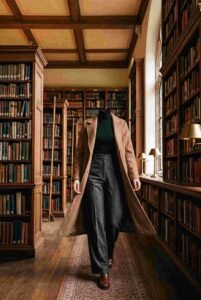
Choose the trouser route: a fitted black turtleneck, high-waisted wool trousers, a thin leather belt, and a long camel or charcoal coat. Finish with loafers or ankle boots.
This combination works because it borrows menswear tailoring without losing shape. It is also the easiest version to repeat twice a week by changing only the knit colour.
For weekends, bookshops, and museums
Relax the structure, not the palette. Try an oversized cardigan over a collared shirt, straight-leg corduroy trousers, and loafers, with the sleeves pushed up once.
A monochrome midi dress also suits weekends well. Choose espresso or forest green, belt it, and wear it with ankle boots and one piece of simple gold jewellery.
For evenings and dinners
Deepen the fabrics rather than adding sparkle. A velvet or dark satin-free midi dress, a fitted blazer over the shoulders, and Mary Janes or heeled ankle boots feel right.
Adjusting the Same System for Each Season
Autumn: the natural home of this style
Autumn needs the least adaptation. Use the full formula: turtleneck, tweed blazer, plaid skirt, tights, and loafers, with a trench on wet days and a wool scarf.
For more cold-weather combinations built specifically around this season, see these dark academia fall outfits for women and note how the same core pieces reappear.
Winter: add weight, keep the shape
Move to heavy wool coats, chunky cable knits, wool trousers, and knee boots. Layer a roll-neck under a blazer under the coat, and let each neckline remain visible.
Rich colours carry winter best: burgundy, navy, forest green, and charcoal. Scarves, gloves, and berets in the same family add warmth without introducing new tones.
Spring: lighten one layer at a time
Drop the heavy coat first and let the blazer become the outer layer. Keep tights on cooler days, then switch to knee socks or bare legs with loafers as it warms.
Summer: change the cloth, keep the codes
Summer is where most people abandon the style unnecessarily. Keep the silhouettes and colours, but rebuild them in linen, cotton, and silk blends that breathe.
Try high-waisted linen trousers with a tucked sleeveless blouse, or a light vest over a short-sleeved shirt with a cotton midi skirt. Loafers still finish both looks.
Shift the palette slightly lighter in heat: more cream, tan, and faded green, less black. The outfit stays recognisably academic without trapping heat.
Accessories: Few, Old-Looking, and Used Daily
Accessories should look inherited or long-owned, not newly themed. One or two per outfit is enough, and the same pieces should reappear across the whole wardrobe.

Start with the bag. A structured leather satchel or crossbody in brown or black is visible in almost every outfit and instantly signals the academic reference.
Next, choose one jewellery language and stick to it. Thin gold or brass lockets, simple rings, small cameo or brooch details, and an analogue watch on a leather strap all work.
Round or oval glasses, a wool scarf, and a plain leather belt complete the set. Avoid novelty book-print bags and costume jewellery, which push the look toward fancy dress.
Building the Wardrobe Without Overspending
This is one of the easiest aesthetics to thrift, because its key pieces were ordinary clothing for decades. Search secondhand listings by fabric and cut, not by the aesthetic name.
Spend first where fit is hardest to fake: the blazer and the coat. A tailor shortening sleeves or nipping a waist often costs less than replacing a jacket that almost fits.
Buy basics new where hygiene and fit matter most. Turtlenecks, tights, and plain shirts are inexpensive new, wear out fastest, and need to fit closely to layer well.
Build in stages. One blazer, one skirt, one trouser, two bases, and one pair of shoes already give you six or more outfits; add the vest, coat, and dress later.
Mistakes That Make the Look Fall Apart
Wearing a costume instead of clothes
Capes, full Victorian collars, corsets, and floor-length dramatic skirts belong to events, not lectures or offices. If you would not wear it on a normal Tuesday, leave it out.
Going all black with no texture
Black on black in identical smooth fabrics reads flat and severe. Add brown, cream, or green, and mix at least two textures so the outfit has visible depth.
Choosing soft, floaty fabrics throughout
Chiffon, loose boho cuts, and unstructured layers drift toward cottagecore or casual dressing. Keep at least one tailored piece, usually the blazer, skirt, or trouser, in every outfit.
Ignoring fit in the name of oversized
Relaxed is fine; shapeless is not. An oversized cardigan works over fitted layers, but an oversized everything hides the tailoring that makes the style recognisable.
Over-accessorising with themed props
Stacking glasses, a beret, a pocket watch, a quill-themed bag, and five rings at once turns clothing into a character. Pick the bag and one other accessory, then stop.
Forgetting the leg and shoe line
Trainers with logos, bare legs in freezing weather, or shiny party heels break the line from hem to floor. Tights plus loafers, Oxfords, or simple boots keep it coherent.
Frequently Asked Questions
What is the simplest dark academia outfit for a woman to try first?
Start with a pinafore dress over a fitted turtleneck, with opaque tights and loafers. It is effectively one purchase plus basics, needs no complex layering, and reads clearly as the aesthetic.
Can dark academia work if I do not wear skirts?
Yes, easily. Use high-waisted wool or corduroy trousers as your main bottom, then apply the same bases, blazer, and shoes. The tailoring and palette matter more than the skirt itself.
Is dark academia suitable for a workplace dress code?
Usually, yes. The trouser formula, a blazer, a turtleneck or Oxford shirt, and loafers sit comfortably inside most business-casual codes, provided colours stay muted and hems stay modest.
How do I wear it in a hot climate?
Keep the colours and shapes, but use linen and cotton, drop to one layer, and choose sleeveless blouses or short-sleeved shirts under a light vest. Skip tights and heavy knits entirely.
Does dark academia have to look old-fashioned?
No. Clean hair and makeup, well-fitted modern trousers, and simple shoes keep it current. The vintage element should come from fabric, cut, and colour, not from looking like a period extra.
Bringing It Together
The outfits women actually keep wearing from this aesthetic are rarely the most elaborate ones. They are the repeatable combinations built from a blazer, a pleated skirt or trousers, a turtleneck, tights, and good flat shoes.
Buy the palette first, learn the layering formula second, and add dresses, vests, and accessories slowly. Done that way, the wardrobe keeps giving you new outfits without needing new clothes every season.