
The short answer: old money shoes for men are five plain, well-made classics — penny loafers, black cap-toe Oxfords, suede chukka boots, double monk straps, and clean white leather sneakers. Buy them in full-grain leather or suede, skip every visible logo, and spend on construction rather than branding.
That formula has barely changed in seventy years, which is precisely why it works. Wealth that doesn’t need to announce itself dresses in shoes that were correct in 1960 and will still be correct in 2040.
This guide breaks down each of the five pairs: what it actually is, when to wear it, what to look for before you pay, and what each should cost at three budget levels. Prices are approximate street prices in US dollars, checked in 2026 — treat them as ranges, not quotes.

Quick Picks: The Five Pairs at a Glance
- Most versatile: Dark brown penny loafers. They cover chinos, tailoring without a tie, and most smart-casual dressing from April to October.
- Most formal: Black cap-toe Oxfords. Weddings, interviews, funerals, evening events — the one pair you cannot substitute.
- Best autumn buy: Suede chukka boots in sand or snuff. They soften flannels, cords, and knitwear better than any other shoe here.
- Most character: Double monk straps. All the polish of a dress shoe with a detail people actually notice.
- Most worn, week to week: Minimalist white leather sneakers. The modern pair, acceptable everywhere the other four are too much.
If you are starting from zero, buy them in that order. And remember that shoes are only half the picture — the same restraint applies above the neck, which is why these pair naturally with classic old money haircuts for men rather than anything trend-driven.
The One Rule Behind All Five: Buy Construction, Not Labels
A Goodyear-welted shoe has its sole stitched to a leather welt instead of glued to the upper. When the sole wears down, a cobbler unpicks the stitching and fits a new one — typically three or four times over the shoe’s life.
That single detail changes the maths completely. A cemented (glued) shoe costing around $150 usually lasts one to three years and cannot be resoled at all. A welted shoe at $350–$450, resoled for roughly $100–$150 a time, routinely serves ten to fifteen years.
Blake stitching sits between the two: slimmer and more flexible than a welt, common on Italian loafers, and resoleable only by a cobbler with the right machine. For a deeper breakdown of how the constructions compare, the Cobbler Union guide to Goodyear welting is worth ten minutes before you spend anything.
1. Penny Loafers: The Pair You’ll Wear Most
What they are
The penny loafer descends from Norwegian fishermen’s slip-ons, reworked by G.H. Bass in 1936 as the Weejuns. The strap across the vamp had a slot that students filled with a coin — legend says a penny, enough for a payphone call.
Close relatives include the tassel loafer (slightly dressier), the horsebit (Gucci, 1953, sharper and more continental), and the soft Belgian loafer. For a first pair, the plain penny in dark brown calf is the most useful shoe in this entire guide.

When to wear them
Chinos, tailored trousers, and suits worn without a tie. Leather pennies with a heeled leather sole can carry a business suit in most modern offices; suede pennies belong with summer tailoring, linen, and knit polos.
They stop working at the extremes: not with shorts-and-a-blazer formality games, and never at black-tie or the most conservative boardrooms. Everywhere between those poles, they are rarely wrong.
What to look for and what to pay
Full-grain leather that creases finely rather than cracking, a sole stitched rather than only glued, and a fit that is snug across the width — loafers stretch and cannot be tightened with laces. Heel slip of more than a few millimetres on day one becomes a flop by month three.
Budget roughly $110–$175 for G.H. Bass Weejuns, around $200–$300 for Meermin or Rancourt, and $550–$700 for Alden’s Leisure Handsewn. A Gucci horsebit sits near $1,000 and buys design, not extra lifespan.
2. Cap-Toe Oxfords: The Formal Non-Negotiable
What they are
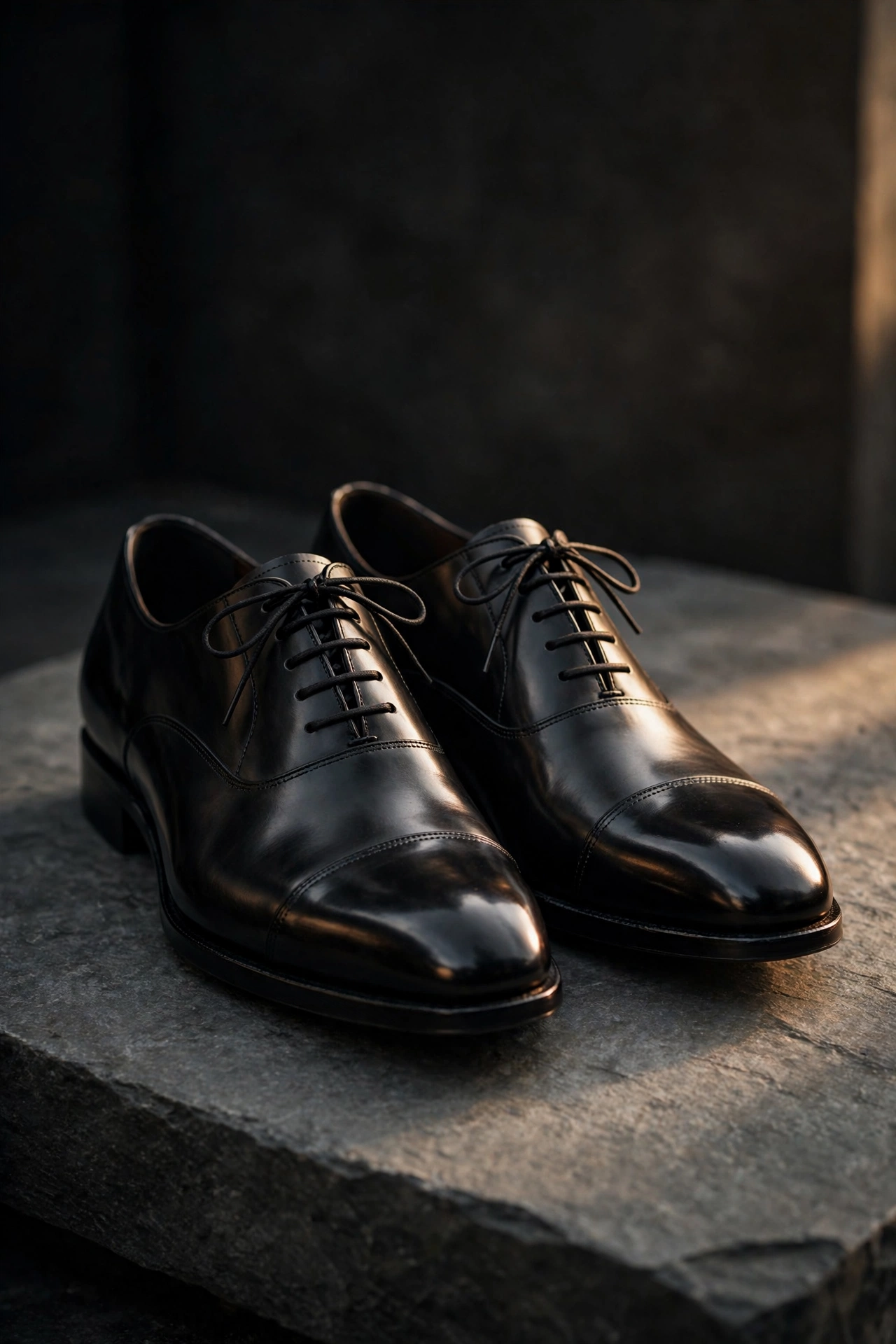
An Oxford is defined by closed lacing: the eyelet panels are sewn underneath the vamp, giving a smooth, unbroken line. The cap toe adds a single horizontal seam across the toe — decoration enough for the most formal shoe most men will ever own.
When to wear them
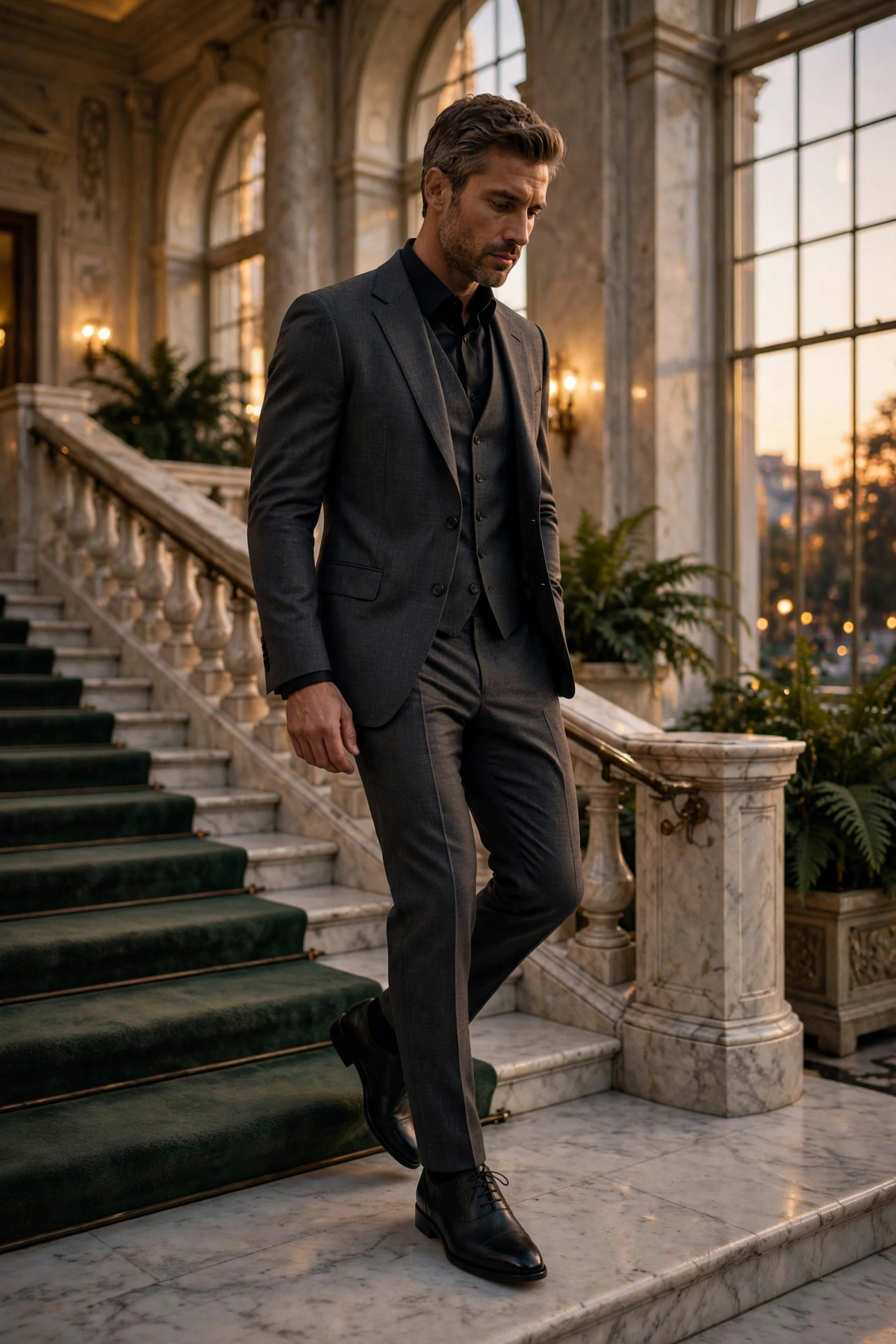
Black cap-toes are the default for weddings, job interviews, funerals, and any evening event short of black tie (where patent leather takes over). With a charcoal or navy suit, nothing else looks as settled.
Brown Oxfords are a daytime shoe: navy and grey suits, yes, but the darker the brown, the wider the range. Heavy broguing moves an Oxford down the formality ladder, so keep your one formal pair plain.
What to look for and what to pay
Closed lacing that meets nearly shut on your foot (a wide V means the fit is wrong), calf leather rather than glossy corrected grain, and a welted sole if they will see regular service. Fit them in the afternoon, when feet are at their largest.
Expect roughly $200–$300 from Meermin, around $400–$450 for Allen Edmonds’ Park Avenue, and $600 and up from Crockett & Jones or Church’s. This is the pair where the premium tier genuinely shows — in the last, the leather grade, and the finish.
3. Suede Chukka Boots: The Autumn Workhorse
What they are
A chukka is an ankle boot with two or three eyelets and an unlined or lightly lined upper. Its most famous form, the desert boot, was modelled on the soft suede boots British officers bought in Cairo’s bazaars during the Second World War; Clarks launched its version in 1949–50 and has barely changed it since.

When to wear them
Chukkas are the bridge between sneakers and dress shoes. Sand or snuff suede over corduroy, flannel, or selvedge denim is one of the most reliable autumn combinations a man can own — most of our men’s fall outfit ideas are built on exactly this base.
They handle smart-casual offices, weekend lunches, and travel days where one pair must do everything. Suede and heavy rain are enemies, though a rubber-soled chukka in darker suede copes with far more weather than the crepe original.

What to look for and what to pay
Real suede with a tight, even nap, and a sole matched to your climate: crepe is authentic and comfortable but slippery and short-lived on wet pavement; a studded rubber sole is the practical choice for most men. Ankle height should end just above the ankle bone.
Clarks Originals desert boots run about $150–$170. Loake and Meermin sit around $250–$350 with better construction, and Alden’s unlined suede chukka reaches roughly $600.
4. Double Monk Straps: Polish With a Point of View
What they are
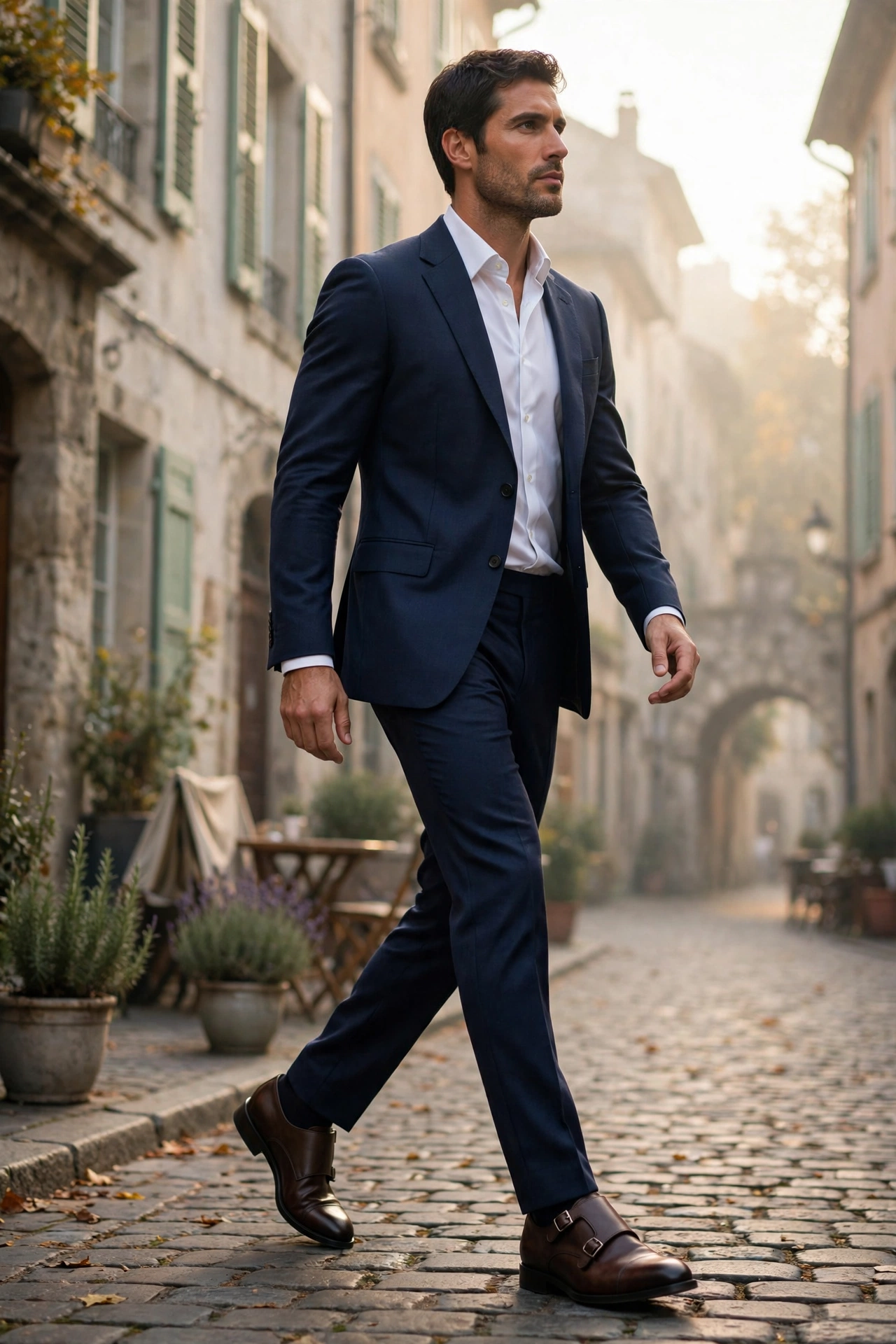
Monk straps close with buckles instead of laces — one strap (single monk) or two (double monk). The design is usually traced to European monks’ sandals, and it occupies a useful middle ground: unmistakably a dress shoe, but with hardware that gives an outfit one deliberate detail.

When to wear them
Anywhere you would wear an Oxford except the very top of the formality scale: business suits, wedding guest outfits, dinners, and smart evenings out. Dark brown doubles under a navy suit are a modern classic; black singles are the quieter route.
Deliberately leave the top buckle undone if you like — a long-standing styling habit that signals you know the shoe rather than borrowed it. Just keep the rest of the outfit clean so the buckles stay the only flourish.
What to look for and what to pay
A sleek, rounded last. Monks in very pointed or squared-off shapes date instantly, and oversized fashion buckles do the same. Check that the straps are full leather with metal — not plastic — buckles, and that the elastic gusset behind the buckle is sturdy.
Prices mirror Oxfords: roughly $200–$300 at Meermin level, $450 and up for Carmina, and $700-plus for Crockett & Jones. Because the style is less universal than an Oxford, buy these fourth, not first.
5. Minimalist White Leather Sneakers: The Modern Fifth Pair
What they are
The template was set in 2004 by Common Projects’ Achilles Low: a plain white leather upper, flat rubber cup sole, no branding beyond a small gold serial stamp. Every clean white sneaker since is a variation on it.

When to wear them
With chinos, white denim, unstructured tailoring, and knitwear — essentially the relaxed half of a classic wardrobe. A slim, spotless pair under a navy blazer and grey trousers is now standard smart-casual in most cities.
The condition is the cleanliness. Scuffed, yellowing sneakers under tailoring don’t read as relaxed wealth; they read as not having bothered. Keep a dedicated cloth and wipe them down after every few wears.

What to look for and what to pay
Smooth leather (not mesh, not canvas), a stitched rather than purely glued sole where possible, and zero visible logos. The silhouette should be low and close to the foot — chunky soles belong to a different wardrobe entirely.
Honest entry points sit around $100–$200 from brands such as Oliver Cabell or Koio’s more accessible lines; Common Projects themselves run roughly $425–$475. Above that, you are paying for a name the design intends to hide.
What to Avoid: The Shoes That Break the Look
Visible logos and monograms. A shoe that advertises its maker contradicts the whole aesthetic. If the branding is the first thing someone notices, it is the wrong shoe.
Square toes and hybrid dress-sneakers. Bicycle-toe “comfort dress shoes” with sneaker soles are neither formal nor relaxed — they are the one category that has never looked expensive on anyone.
Over-designed fashion shoes. Pointed toes curving upward, patent finishes outside evening wear, metallic leathers, and this season’s platform soles all share one trait: a built-in expiry date.
Cheap construction at premium prices. Glossy “corrected grain” leather that creases into white cracks, and cemented soles sold at welted prices, are the worst value in menswear. Check the construction spec before the brand name.
Wearing one pair into the ground. Even a superb shoe dies early if it never rests. Daily wear without rotation is the fastest way to ruin a $500 pair — see the care rules below.
Care: How These Shoes Actually Last a Decade
Rest every pair 24–48 hours between wears. Leather absorbs roughly its own weight in moisture from your feet over a long day. Shoes worn back-to-back never fully dry, and the lining rots from the inside where no polish reaches.
Cedar shoe trees, in immediately after wear. Heritage makers like Cheaney call the wooden tree the single most important care step: it absorbs that moisture, holds the shape, and flattens creases before they set and crack.
Brush after every wear; cream polish every 10–15 wears. Thirty seconds with a horsehair brush removes the grit that abrades leather. Cream polish restores pigment and oils; add wax polish on the toe and heel only, where scuffs and shine matter most. Condition two or three times a year — over-conditioning softens leather too far.
Suede plays by different rules. Never put cream or wax on it. Brush dry dirt out with a stiff suede brush, lift marks with a suede eraser, and apply a protector spray at the start of the season.
Wet shoes dry slowly or not at all. Stuff them with newspaper, keep them away from radiators and direct heat, and give them a full day. Heat-dried leather cracks exactly where it bends.
Resole before you wear through. Once the sole thins to the cork or welt, repair costs climb and sometimes become impossible. A timely resole at roughly $100–$150 is what turns a purchase into a fifteen-year asset.
Frequently Asked Questions
If I can only afford one pair, which should it be?
Dark brown penny loafers. They cover the widest range of real life — work, dinners, travel, weekends — and only fail at genuinely formal events, which are rarer than most men expect. Add the black Oxfords second.
Can loafers really be worn with a suit?
Yes, with conditions: a leather (not suede) penny or tassel loafer, a leather sole, and a suit that isn’t at the most formal end. It works for most offices and summer weddings. For interviews in law or finance, wear the Oxfords.
Are Goodyear-welted shoes worth the extra money?
If you will wear them weekly, yes. The ability to resole three or four times drops the cost per year well below a glued shoe replaced every two years. For a pair worn twice a year, the premium buys longevity you’ll never use.
How long should a good pair of leather shoes last?
Ten to fifteen years is realistic for a welted pair in rotation with basic care; heritage makers document customers at twenty-plus. A cemented pair typically gives one to three years before the sole fails with no repair option.
Black or brown — which is more versatile?
Brown, across a whole wardrobe: it pairs with navy, grey, olive, and denim. Black wins only where formality is the point. That is why the brown loafer is the first buy and the black Oxford the specialist second.
Build the rotation in order, buy the best construction your budget reaches, and maintain it with trees and rest days. Do that, and your shoes will quietly outlast every trend cycle that passes over them.